Plastic Injection Molding for EV Components: Materials, Applications & Manufacturing Challenges
Table of Contents
- Introduction
- What is Plastic Injection Molding for EV Components?
- Why EVs needs Injection Molded Plastic Components?
- Best Plastic Material for EV Components
- Application of EV Injection Molding
- How OPM Helps
- Conclusion
The rapid growth of electric vehicles (EVs) is transforming the automotive industry. As manufacturers look for ways to make vehicles lighter, safer, more efficient, and more cost-effective, high-performance plastic components are becoming increasingly important. Plastic Injection Molding for EV Components offers manufacturers a scalable solution for producing precise, durable, and lightweight parts in high volumes.
From battery housings and electrical connectors to charging components and interior parts, plastics are used across many areas of an electric vehicle. However, producing these components requires careful material selection, advanced tooling, precise process control, and strict quality standards.
In this blog, we explore the role of EV injection molding, commonly used materials, major applications, manufacturing challenges, and how OPM India can support EV component production.
What Is Plastic Injection Molding for EV Components?
Plastic Injection Molding for EV Components is a manufacturing process in which plastic pellets are heated until molten and injected into specially designed molds under controlled pressure. Once the material cools and solidifies, the finished component is ejected from the mold.
The process is particularly suitable for electric vehicle manufacturing because it can produce complex components with consistent dimensions and repeatable quality. It also supports high-volume production, making it suitable for automotive applications where thousands or millions of components may be required.
With modern automation and process monitoring, Injection molding for electric vehicles can help manufacturers achieve tight tolerances, reduce material waste, and maintain consistent production quality.
Why EVs Need Injection-Molded Plastic Components?
Electric vehicles have different manufacturing requirements compared with conventional internal combustion engine vehicles. Weight reduction, electrical insulation, thermal management, and safety are critical considerations.
Injection-molded plastics offer several advantages:
- Lightweight compared with many metal alternatives
- Excellent electrical insulation
- Design flexibility for complex geometries
- High production repeatability
- Resistance to chemicals and corrosion
- Potential for integrating multiple functions into a single component
- Compatibility with automated mass production
- Opportunities for recyclable and engineered materials
As EV adoption increases, Plastic injection molding for EV applications is expected to become increasingly important across automotive supply chains.
Best Plastic Materials for EV Components
Selecting the right material is one of the most important steps in EV component manufacturing. Different applications require different combinations of mechanical strength, temperature resistance, electrical insulation, flame resistance, dimensional stability, and chemical resistance.
Some commonly considered materials include:
1. Polyamide (PA)
Polyamide, including reinforced grades such as glass-filled nylon, is widely used for applications requiring strength, durability, and temperature resistance. It can be considered for various structural and under-the-hood EV components.
2. Polycarbonate (PC)
Polycarbonate offers good impact resistance, dimensional stability, and electrical insulation properties. It can be useful for selected electrical and electronic applications.
3. Polypropylene (PP)
PP is lightweight, cost-effective, and resistant to many chemicals. It is commonly used for automotive plastic components and can support weight-reduction objectives.
4. ABS
ABS provides a useful combination of strength, impact resistance, surface finish, and processability. It can be suitable for selected interior and electronic housings.
5. PBT
Polybutylene terephthalate (PBT) is valued for dimensional stability, electrical properties, and resistance to heat and chemicals, making it useful for certain automotive electrical components.
6. High-Performance Engineering Plastics
For demanding applications, manufacturers may consider high-performance polymers that offer enhanced temperature resistance, mechanical performance, flame resistance, or chemical stability.
The Best plastic materials for EV components ultimately depend on the component’s operating environment, design requirements, safety specifications, electrical characteristics, temperature exposure, and regulatory requirements.
Applications of EV Injection Molding
The growing EV ecosystem has created demand for a wide variety of injection-molded components.
EV Battery Components
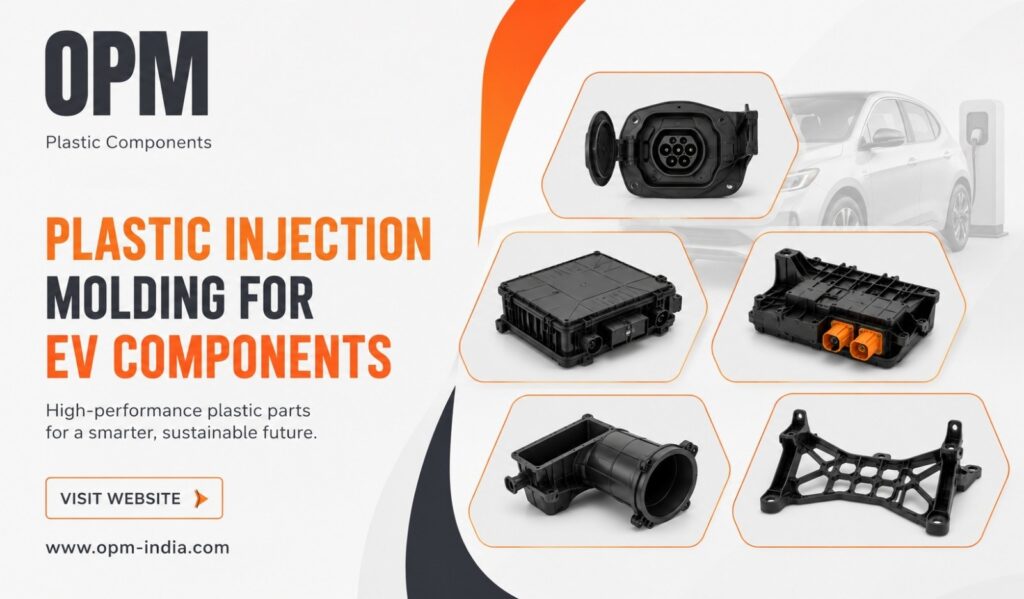
Battery systems require carefully designed housings, covers, brackets, connectors, insulation components, and other supporting parts. Materials may need to withstand heat, vibration, chemicals, and electrical requirements.
Electrical Connectors and Enclosures
Connectors, terminal housings, cable management components, and electronic enclosures require dimensional accuracy and reliable electrical insulation. Injection molding allows manufacturers to produce intricate geometries with repeatable results.
Charging Components
EV charging systems contain multiple plastic components, including connector housings, protective covers, cable components, and internal structural parts. These components require appropriate mechanical and electrical properties.
Electric Motor Components
Plastic components may be used in selected motor-related applications, including insulation, covers, connectors, and other supporting parts.
Interior Components
Weight reduction is important throughout an EV. Injection-molded plastics can be used for dashboards, trim parts, brackets, storage components, housings, and other interior applications.
Power Electronics
Power control systems and electronic modules require protective housings, connectors, brackets, and insulation components. Proper material and mold design are essential for achieving reliable performance.
Key Manufacturing Challenges
Although EV injection molding offers many advantages, manufacturing EV components comes with specific challenges.
Material Selection
Choosing a material that meets mechanical, thermal, electrical, flame-retardancy, and chemical requirements can be complex. A material that works well for one EV application may not be appropriate for another.
Tight Dimensional Requirements
Electrical connectors, battery components, and precision assemblies often require accurate dimensions. Even small variations can affect component fit and overall assembly performance.
Thermal Management
Some EV components operate near heat-generating systems. Materials and designs must therefore be evaluated for their ability to perform under the expected temperature conditions.
Complex Mold Design
EV components can feature thin walls, intricate geometries, clips, ribs, bosses, and other design elements. Proper mold-flow analysis and tooling design can help minimize defects and improve manufacturability.
Quality and Consistency
Automotive manufacturing requires reliable and repeatable production. Process parameters such as injection pressure, temperature, cooling time, and cycle time must be carefully controlled.
Sustainability
EV manufacturers are also focusing on reducing manufacturing waste and increasing the use of recycled or more sustainable materials where technically and commercially appropriate.
How OPM Helps
OPM India supports manufacturers looking for reliable solutions for EV plastic component manufacturing in India. With expertise in plastic injection molding and automotive applications, OPM India can support projects from component development through production.
Design and Engineering Support
A successful injection-molding project begins with a manufacturable design. OPM India can support component design considerations, tooling requirements, and design-for-manufacturing principles to help identify potential production challenges early.
Tooling and Mold Development
Precision tooling is essential for producing consistent EV components. OPM India can assist with mold development and tooling solutions designed around the component’s geometry, material, production volume, and quality requirements.
Injection Molding Production
OPM India provides injection molding capabilities for producing plastic components with repeatable quality. Process control and production planning help support consistent output for automotive and EV applications.
Material Selection Support
Choosing the right polymer can significantly influence component performance and manufacturing cost. OPM India can help customers evaluate suitable material options based on application requirements and production objectives.
Quality-Focused Manufacturing
For EV applications, dimensional accuracy and repeatability are important. OPM India’s manufacturing approach focuses on maintaining production consistency and meeting defined component specifications.
As an experienced plastic injection molding manufacturer in India, OPM India can support businesses seeking dependable manufacturing solutions for automotive and emerging EV applications.
Conclusion
Plastic Injection Molding for EV Components is playing an increasingly important role in the development of lightweight, efficient, and reliable electric vehicles. From battery and charging components to connectors, electronic housings, and interior parts, injection-molded plastics provide the design flexibility and production scalability required by modern EV manufacturing.
However, successful EV component manufacturing depends on more than simply selecting a plastic material. Material performance, mold design, dimensional accuracy, process control, quality management, and manufacturability must all work together.
If you are planning a new EV component or looking for a reliable manufacturing partner, OPM India can help you move from design and tooling to production with a practical, quality-focused approach.
Looking for reliable EV plastic component manufacturing in India? Partner with OPM India for precision plastic injection molding solutions. Contact us today to discuss your EV component manufacturing requirements and take your project from concept to production.