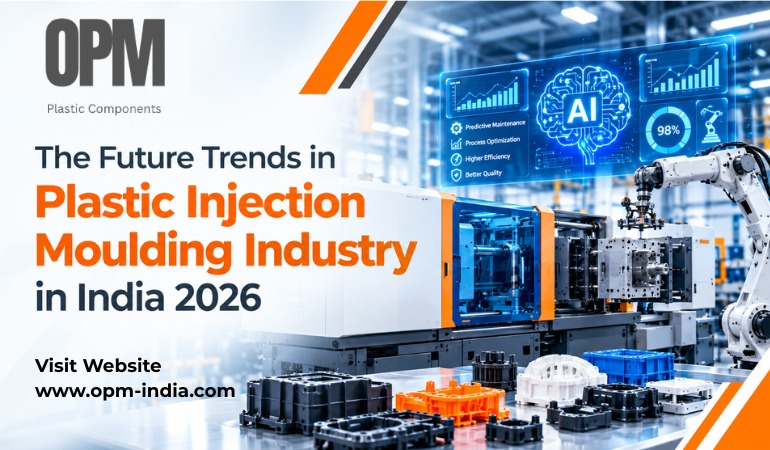
The Future Trends in Plastic Injection Moulding Industry in India (2026 & Beyond)
Table of Contents
- Introduction
- Future Trends in Plastic Injection Moulding Industry in India
- How OPM Helps
- Conclusion
The Plastic Injection Moulding Industry in India is entering a new phase of growth driven by automation, sustainability, advanced materials, precision engineering, and increasing demand from automotive, electronics, healthcare, packaging and consumer-product manufacturers.
India’s injection-moulded plastics market was estimated at approximately USD 27.84 billion in 2024 and is projected to grow at a CAGR of 5.5% between 2025 and 2030. Injection moulding also represented around 35.45% of India’s plastics processing market in 2025, highlighting its importance to the country’s manufacturing ecosystem. Grand View Research+1
As manufacturers move toward Industry 4.0 and more sustainable production models, what can businesses expect from 2026 and beyond?
1. Automation and Smart Manufacturing Will Become the Standard
One of the biggest trends shaping the future of injection moulding is automation.
Robotic part removal, automated material handling, machine monitoring, automated inspection and process-control systems are increasingly becoming essential rather than optional. Modern injection moulding machines can collect production data in real time, helping manufacturers identify variations, reduce downtime and improve consistency.
For high-volume manufacturing, automation can also help reduce cycle times and dependency on manual processes while improving repeatability.
The broader manufacturing sector is already demonstrating this transition. Recent investments in automated injection moulding equipment, robotic arms and CNC technologies are being used to improve productivity, cycle time and energy efficiency. The Financial Express
For Plastic Injection Moulding companies in India, investing in smart production capabilities will be an important competitive advantage.
2. Sustainability and Recycled Materials Will Gain Greater Importance
Sustainability is becoming one of the defining trends for the plastics industry.
Manufacturers are increasingly exploring recycled polymers, bio-based materials, lightweight designs and processes that minimise scrap and energy consumption. This shift is being driven not only by customer expectations but also by India’s evolving regulatory framework.
Under India’s Plastic Waste Management framework, recycled-content obligations are increasing. For example, the 2026 rules specify recycled plastic content targets for packaging, with Category I packaging moving from 30% in 2025–26 to 40% in 2026–27 and eventually 60% from 2028–29 onwards, subject to applicable exemptions. IndiaCode by eCourtsIndia
This means manufacturers will need to consider recyclability and material selection much earlier in the product-development process.
Future-focused Plastic Injection Moulding services in India will therefore increasingly combine production efficiency with material optimisation and waste reduction.
3. AI, Data Analytics and Digital Twins
Artificial intelligence and data analytics are expected to transform moulding operations.
Manufacturers can use production data to monitor parameters such as temperature, pressure, cycle time and machine performance. AI-assisted systems can potentially identify patterns associated with defects and maintenance requirements before they become costly production problems.
Digital twins and mould-flow simulation are also becoming increasingly useful during mould development. Engineers can evaluate gate locations, cooling strategies, filling behaviour and potential defects virtually before manufacturing the physical tool.
This can reduce development iterations, minimise tooling risks and accelerate time-to-market.
4. Advanced Materials and Lightweight Components
Demand for lighter and stronger components is increasing, particularly in automotive and electric-vehicle applications.
Engineering plastics, reinforced polymers and high-performance thermoplastics are enabling manufacturers to replace heavier metal components in selected applications while maintaining strength and dimensional stability.
Lightweighting is especially relevant to electric vehicles, where reducing component weight can contribute to overall vehicle efficiency.
At the same time, consumer electronics and medical-device manufacturers are demanding tighter tolerances, improved surface finishes and increasingly complex geometries.
This will create opportunities for Plastic Injection Moulding companies in India with advanced tooling, material expertise and precision manufacturing capabilities.
5. Multi-Material Moulding and Overmoulding
Multi-shot moulding and overmoulding are another important area of development.
These processes allow manufacturers to combine different materials or colours within a single component, potentially reducing secondary assembly operations.
Applications include automotive interiors, handles, electrical components, consumer products and specialised industrial parts.
As product designs become more sophisticated, the ability to manufacture complex components efficiently in fewer production stages will become increasingly valuable.
6. 3D Printing Will Support Faster Tool Development
Additive manufacturing is not expected to replace injection moulding for mass production. Instead, it will increasingly complement the process.
3D printing can support rapid prototyping, low-volume validation and the development of specialised mould inserts. Advanced tooling approaches such as conformal cooling can also help improve mould temperature management and cycle efficiency.
This combination of additive manufacturing and conventional injection moulding can shorten product-development cycles and allow companies to test designs before committing to large-scale production.
7. Precision Manufacturing Will Expand
Industries such as healthcare, electronics, automotive and electrical equipment increasingly require components with tight dimensional tolerances and consistent quality.
Consequently, the future Plastic Injection Moulding Industry in India will be less focused simply on producing large quantities and more focused on producing technically demanding components with repeatable quality.
Quality inspection, tool maintenance, process validation and traceability will become increasingly important selection criteria when businesses evaluate a Plastic Injection Moulding company in India.
8. Pune Will Remain an Important Manufacturing Hub
Pune has established itself as an important automotive and engineering manufacturing centre, making it a strategically valuable location for injection moulding suppliers.
The concentration of OEMs, Tier-1 suppliers, engineering companies and skilled manufacturing professionals creates opportunities for specialised moulding companies serving automotive, industrial and consumer applications.
Businesses looking for Plastic Injection Moulding companies in Pune are increasingly seeking suppliers capable of providing more than production alone—including tooling, prototyping, quality control, assembly, logistics and technical support.
How OPM Helps
OPM India brings decades of experience to the evolving injection moulding sector. Established in 1963, OPM provides an integrated plastic manufacturing solution covering design, tooling, injection moulding, assembly, logistics and delivery. OPM
OPM’s capabilities align closely with the requirements of next-generation manufacturing.
Its services include:
- Design & tooling: OPM’s tooling division supports mould design, tool manufacturing, refurbishment, modification, repair and preventative maintenance. Its facility uses CNC machining and EDM technologies.
- Product development and prototyping: OPM evaluates product complexity, material requirements and tooling configurations before production.
- Injection moulding: Advanced machinery enables production of medium-to-large plastic components with a focus on consistency and repeatability.
- Assembly and logistics: OPM offers package and assembly services along with storage and worldwide distribution support.
- Engineering knowledge: Its long experience enables customers to receive support throughout the product-development and manufacturing lifecycle.
For companies evaluating Plastic Injection Moulding companies in Pune, OPM India offers the advantage of combining tooling, production and supporting manufacturing services under one solution.
Conclusion:
The future of the Plastic Injection Moulding Industry in India looks promising. From smart manufacturing and AI-driven process monitoring to recycled materials, lightweight components, advanced tooling and precision moulding, the industry is moving toward a more technology-driven and sustainable future.
India’s growing domestic consumption, manufacturing investments and export potential are creating new opportunities for capable moulding suppliers. At the same time, customers are becoming more demanding about quality, sustainability, speed and cost efficiency.
Choosing the right manufacturing partner will therefore be critical.
Whether you need product development, tooling, prototyping, high-volume production, assembly or complete Plastic Injection Moulding services in India, OPM India can support your project from concept to finished component.
Looking for a reliable Plastic Injection Moulding company in India? Partner with OPM India to build efficient, precise and future-ready plastic components. Contact the OPM India team today to discuss your next project and request a customised manufacturing solution.